Beyond the Post-Mortem: Why Waiting Until the End of the Job is a Financial Risk
For many contracting companies with 5 to 100 field workers, the most stressful day of the month isn't the deadline—it’s the day the final job costing report arrives. By the time an operations leader sees that a project finished 15% over budget, the opportunity to fix it has passed. The mobilization costs are paid, the labor is spent, and the margin is gone. This is the 'post-mortem trap': analyzing what went wrong when it is too late to do anything about it.
In an industry where the 2024 CFMA Construction Financial Benchmarker reports average net income before taxes at approximately 6.3%, there is no room for lag time. A single mismanaged week on a major project can wipe out the entire profit for that job. To protect these thin margins, operations leaders are moving away from historical reporting and toward active margin management using real-time variance analysis.
Labor: The Primary Variable in Your Margin Equation
While material costs are often locked in via purchase orders, labor remains the most volatile factor in any project. In most trades, labor accounts for over 50% of total job costs. It is also the hardest to track without the right systems. When you are trying to understand how do contractors track job profitability, the answer usually starts with connecting estimated hours to actual labor on a daily basis.
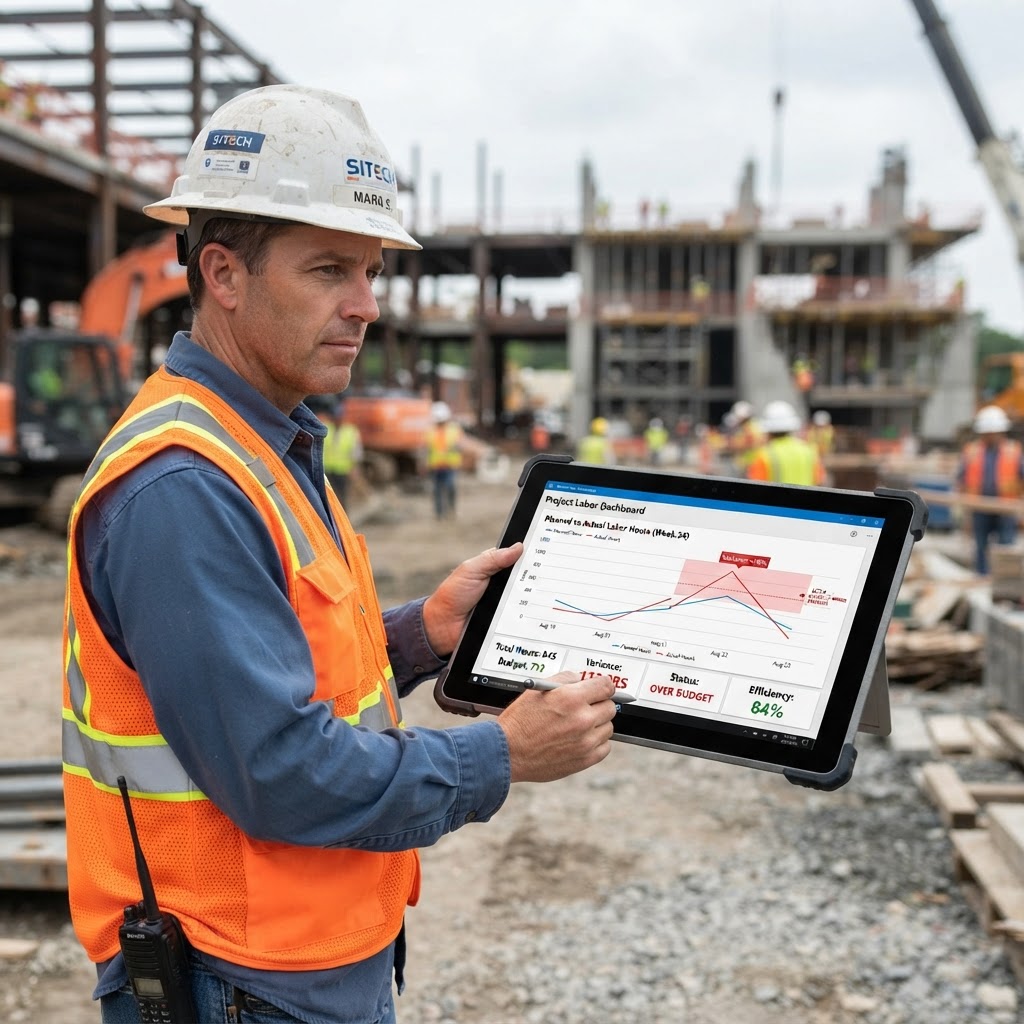
If you aren't seeing daily inputs from the field, you are managing by intuition rather than data. Real-time visibility allows you to see if a crew of eight spent 60 hours on a task estimated for 40—before that trend carries into the next phase of the project.
Identifying 'Red Flag' Variances Before They Compound
Effective mid-job correction relies on identifying variance early. A 'variance' is simply the difference between what you planned (the estimate) and what is actually happening (the production). Operations leaders should look for specific red flags that indicate a project is heading off course:
- The 50/70 Rule: If a project phase is 50% physically complete but has consumed 70% of the estimated labor hours, your margin is eroding. Without intervention, this phase will likely finish significantly over budget.
- Stagnant Production: If labor hours are being logged but the 'percent complete' on a specific task hasn't moved for two days, there is a bottleneck that needs immediate attention.
- Daily Overtime Spikes: Consistent overtime that wasn't in the original estimate is a leading indicator of poor scheduling or unforeseen site complications.
Using job costing software for contractors allows ops leaders to set automated alerts for these specific thresholds. Instead of digging through spreadsheets, you get a notification when a specific cost code exceeds its projected burn rate.
Fact-Finding vs. Blame: Investigating the 'Why'
When the data shows a negative variance, the goal isn't to assign blame to the foreman. The goal is to identify the root cause so you can course-correct. A variance usually stems from one of three areas:
1. Estimating Errors
Sometimes the bid was simply wrong. Perhaps the estimator missed the complexity of the site or used outdated production rates. Identifying this mid-job allows you to adjust your projections for the remainder of the work and update your bidding library for future projects.
2. Site Conditions and Inefficiencies
Is the crew waiting two hours every morning for another sub-contractor to move their equipment? Is a piece of rented machinery malfunctioning? Real-time variance analysis highlights these inefficiencies while they are happening, allowing operations to call the general contractor or the rental yard to resolve the issue immediately.
3. Scope Creep
This is the most common 'silent killer' of contractor margins. Field crews often perform 'small' favors for the client that aren't in the original contract. If your labor hours are spiking but your scheduled tasks aren't progressing, your crew might be performing unbilled work.
Using Variance as a Change Order Trigger
One of the most practical applications of construction operations software is its ability to serve as a tripwire for change orders. When a foreman realizes that a task is taking 30% longer because the site conditions differ from the blueprints, that data needs to move from the field to the office instantly.
By tracking actuals against the estimate in real-time, you have the documentation needed to justify a change order. It is much easier to get a change order signed while the crew is standing in the dirt dealing with the problem than it is to argue for extra payment three weeks after the job is finished.
Operational Workflow: The Weekly Pulse
Protecting margins doesn't require hours of extra administration. It requires a consistent workflow. We recommend a 'Weekly Pulse' meeting for operations leaders and project managers:
- Review Top 3 Variances: Identify the three tasks across all active jobs with the highest labor hour variance.
- Determine the 'Why': Is it a bid error, a site issue, or scope creep?
- Execute Correction: This might mean reallocating a high-production crew to a struggling job, filing a change order, or adjusting the schedule to avoid liquidated damages.
Conclusion: Visibility is Control
You cannot manage what you cannot see. While historical reports are useful for long-term planning, mid-job course correction is what saves your current month’s bottom line. By focusing on labor variance and moving toward construction operations software that provides a real-time link between the field and the office, you protect that critical 6.3% margin from being nibbled away by avoidable inefficiencies.
Legal Disclaimer: Pricing and feature comparisons mentioned in industry research are time-stamped as of late 2024 and are subject to vendor changes; verify current details with each individual software vendor. Average net income data is based on 2024 CFMA benchmarks and may vary by trade and region.
Ready to see your labor variance in real-time? Book a working demo with SiteSlate today.