Beyond the Spreadsheet Ceiling: The Operational Reclamation of Time and Margin
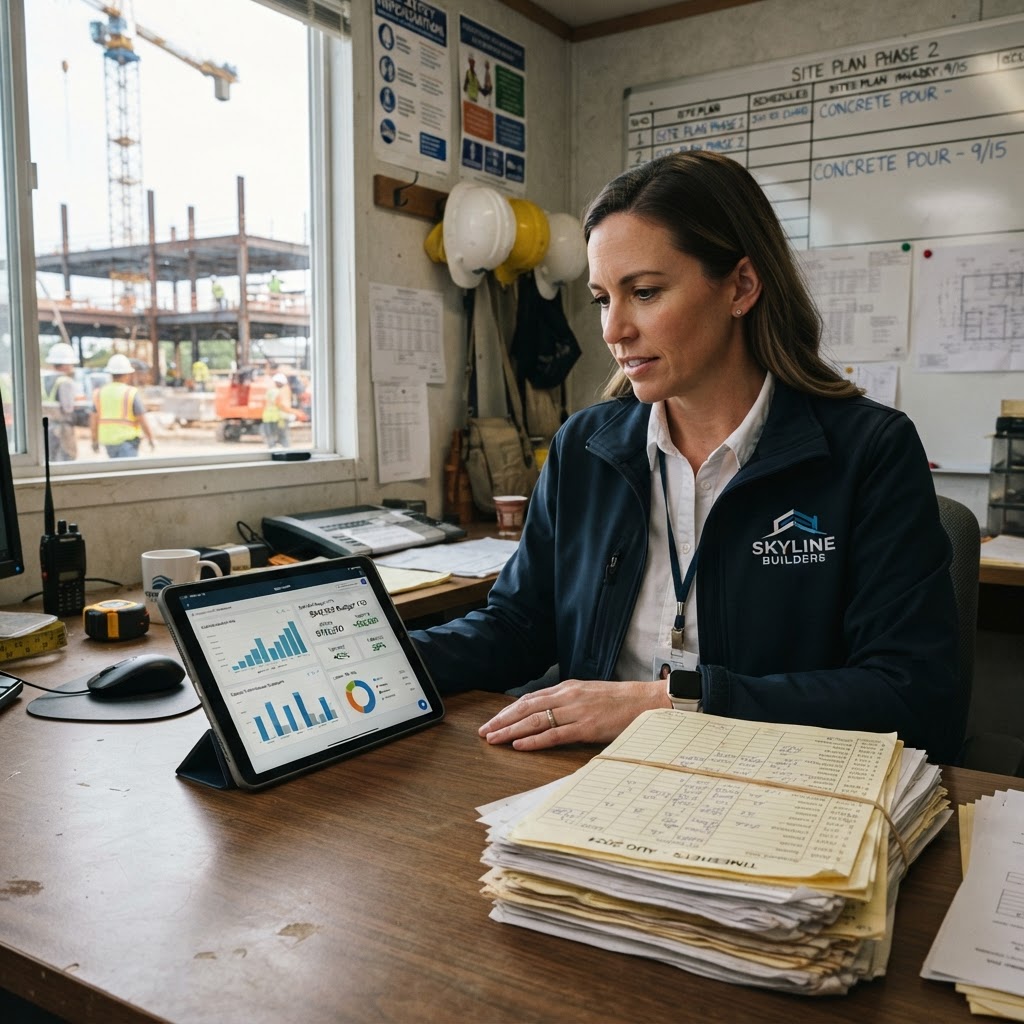
If your crew of 40 is still tracking hours on paper and manually porting them into an Excel workbook, you are likely leaking labor cost into every job. In the early stages of a contracting business, spreadsheets are the ultimate tool—flexible, free, and familiar. However, for companies scaling between 5 and 25 field workers, those same spreadsheets eventually turn into a ceiling. This is the point where the manual effort required to keep data synchronized between estimating, scheduling, and invoicing begins to fail.
The Invisible Admin Tax: 10–15 Hours of Data Babysitting
For owners and operations leaders of 5–100 person companies, the move to integrated software isn't just about a tech upgrade; it is an operational reclamation. We call the current state the 'Invisible Admin Tax.' This tax is the 10–15 hours per week that senior leaders or office managers spend 'babysitting' data. This includes chasing down text messages for hours worked, correcting illegible paper timesheets, and cross-referencing material receipts against job folders. When you ask, 'when should a contractor replace spreadsheets?', the answer is usually 'six months ago.' If your office staff spends more time moving data than analyzing it, you have reached the spreadsheet ceiling.
The 90% Error Rate: Why Your Job Costing is a Guess
Research into manual data management consistently shows a documented error rate of nearly 90% in complex spreadsheets. In the context of a construction project, a single typo in a labor hour column can skew a job's profitability report by thousands of dollars. More dangerously, these 'invisible' profit leaks are rarely discovered in real-time. Without an integrated system, job costing remains a month-end guess rather than a daily management tool. You don't find out a project went over budget until three weeks after it closed—long after you have the opportunity to adjust crew levels or material spend.
How Scheduling and Time Tracking Connect to Job Costing
The right contractor operations platform connects estimated hours to actuals so job costing is real. To understand how scheduling and time tracking connect to job costing, look at the flow of data. In an integrated system, a field worker clocks into a specific cost code via a mobile app. That clock-in data does three things simultaneously: 1) It updates the live project budget against the original estimate. 2) It verifies the worker's location against the scheduled job site. 3) It prepares the labor line item for the next invoice. This eliminates the 5–10 day delay inherent in manual entry from paper or text messages. Real-time margin control can improve by 15–25% when field data flows instantly into the office's budget-vs-actual reports.
What is the Best Software for a 5–50 Person Contracting Company?
When evaluating the market for 2026, the 'best' software is often an all-in-one platform rather than a 'best-of-breed' stack. For a 5-50 person company, adopting a fragmented stack—using one app for GPS tracking, another for scheduling, and a third for invoicing—creates 'app fatigue.' The administrative cost of managing multiple integrations, logins, and monthly subscriptions can be as labor-intensive as the spreadsheets they replace. Furthermore, enterprise-level tools like Procore, while powerful, often require a full-time administrator to manage the complexity, making them a risky 'over-buy' for mid-sized contractors. Legal Disclaimer: Pricing and feature comparisons are time-stamped as of late 2024 and are subject to vendor changes; verify current details with each vendor.
2026 Pricing Benchmarks and Comparison
Based on projected 2026 benchmarks, point solutions (like standalone time trackers) typically cost $10-$20 per user per month but leave the 'integration gap' wide open. Enterprise suites can range from $1,200 to $5,000+ per month with multi-year commitments. For the 5–100 person firm, the middle ground—integrated operations platforms—provides the most utility. These platforms generally range from $200 to $800 per month depending on feature sets like advanced job costing and equipment tracking. The value isn't just in the subscription price, but in the elimination of the 15 hours of manual admin work.
The Risks of Transition: Garbage In, Garbage Out
The transition to integrated operations is not without risk. Moving poor-quality spreadsheet data into a new system often leads to 'garbage in, garbage out' results during the first 90 days of implementation. Before migrating to SiteSlate or any other platform, operations leaders must audit their current cost codes and employee records. The goal is to start with a clean slate so the automated reports are immediately actionable. Avoid the trap of trying to automate a broken process; fix the process on paper, then lock it in with software.
Conclusion: Reclaiming Your Margin
Transitioning from spreadsheets to integrated operations is a fundamental shift from being reactive to being proactive. It moves the focus from 'what happened last month' to 'what is happening on Site A today.' For the contractor looking to scale from 10 field workers to 50, this infrastructure is as essential as the trucks and tools used on-site. Stop paying the invisible admin tax and start managing your margins in real-time. Ready to see how SiteSlate can streamline your operations? Book a working demo today.